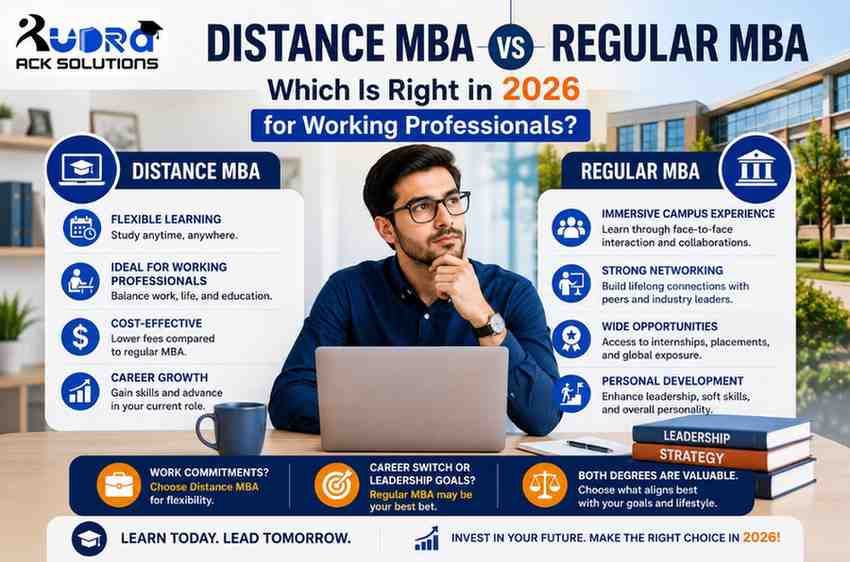
Distance MBA vs Regular MBA: Which Is Right for You When You're a Working Professional in 2026?
Getting an MBA is a sure way to boost a person's career and income, and help in achieving upper management roles. But, in 2026, professionals have a real choice to make beyond the type of specialization, and that is whether to get a Distance MBA or a Regular MBA (Full-time).
Choosing either option will provide the candidate with the same degree, however, the price, experience level, time, and the effect it has on one's career can be very different. Here at Rudraack Solutions, we assist thousands of working professionals make this choice, each and every year. In our experience, the right choice is typically very personal, and is based on the individual's current career, finances and aspirations, rather than what is most popular.
Within this guide, you'll find everything from eligibility and fees to Distance MBAs and Regular MBAs, and the career outcomes associated with each to help simplify the choice for you, as we want you to feel educated and confident in your decision.
What is a Distance MBA?
A Distance MBA (which is also referred to as an Online MBA or a Correspondence MBA) is a management related degree which can be obtained from a Distance (as opposed to getting a degree from a college or university which involves a lot of time spent on campus, and therefore, daily classes).
With Distance MBAs, students find learning materials online, along with recorded lectures, and are aided in their study with periodic contact sessions.
Distance MBA programs are recognized as legit (and are not scams) by the University Grants Commission (UGC) and the Distance Education Bureau (DEB). However, the university offering Distance MBAs has to be UGC-DEB approved.
Who Benefits Most From This?
- Working professionals that can't leave their job
- Entrepreneurs/business owners
- Individuals from tier-2/tier-3 cities that don't have access to top B-schools
- Those looking for a more affordable way to upskill
What Is a Regular MBA?
A Regular MBA is a full-time, on-campus program that spans two years (four semesters). It has daily classes and features group assignments and live case studies, includes internships and offers on-campus placement opportunities. Classroom-based MBA programs are conducted by universities, IIMs and private B-schools.
Who It Benefits Most
- Individuals that have recently graduated and have little work experience
- Those looking to change careers and move into consulting, finance or product management
- Individuals that are looking to secure campus placements and want to develop a strong network with peers
- Individuals that can devote 2 years to studies
Distance MBA vs Regular MBA: Main Differences
Mode of Study
- Distance MBA: Online or self-paced with study material
- Regular MBA: On-campus, classroom-based
Duration
- Distance MBA: 2-4 years (flexible)
- Regular MBA: 2 years (fixed)
Fees
- Distance MBA: ₹15,000 – ₹1,50,000 (total)
- Regular MBA: ₹2,00,000 – ₹25,00,000+ (total)
Eligibility
- Distance MBA: Graduation (some allow lateral entry)
- Regular MBA: Graduation + entrance exam (CAT/MAT/XAT/CMAT)
Placements
- Distance MBA: Usually not offered
- Regular MBA: Campus placements available
Networking
- Distance MBA: Limited peer interaction
- Regular MBA: Strong peer and alumni network
Flexibility
- Distance MBA: High — study while working
- Regular MBA: Low — requires full-time commitment
Recognition
- Distance MBA: UGC-DEB approved programs are valid for jobs and promotions
- Regular MBA: Recognized by AICTE/UGC, generally higher brand value
Ideal For
- Distance MBA: Working professionals, entrepreneurs
- Regular MBA: Freshers, career switchers
Comparison of Cost: Where the Real Difference Is
Cost is often the single most important factor that is considered and there is a considerable gap between the two formats.
Distance MBA: Depending on the university and chosen specialization, this can set you back anywhere between ₹15,000 and ₹1,50,000. There are no other major costs to worry about, including hostel charges, moving costs, or lost wages.
Regular MBA: On the low end, you are looking at costs (tuition, hostel, etc.) upwards of ₹10-15 lakh, and significantly more at the top institutes. To top it all off, students give up 2 years of their salary.
Read More:- Best Online MBA University in India 2026 – Top Picks, Fees & Admission Guide
For someone who is already working, the effect incurred (tuition, lost salary) of a Regular MBA is easily 5-10x more compared to a Distance MBA.
Career Impact and ROI
This is where things get a little more complicated, and this is the most common place most people seek understanding.
Regular MBA ROI: Regular MBA programs placed among top institutes lead to better salary prospects from day one owing to on-campus placements. A Regular MBA works best for:
- Switchers to a different industry from the ones that offer on-campus placements
- Freshers with less than two years of work experience
- Individuals looking to enter consulting, investment banking, and product management roles where the hiring firm considers the institute's brand during recruitment
Distance MBA ROI: A Distance MBA has no on-campus placements and hence is unlikely to yield better salary prospects on placement. The ROI for a Distance MBA is seen on:
- Getting promoted within your organization
- Meeting the minimum qualification for government or Public Sector Unit (PSU) jobs
- Giving a boost for an entrepreneurial venture
- Better prospects for clearing higher-level government job exams
For a working professional who is already earning a good salary, a Distance MBA has the best ROI since the cost is less and there is no opportunity cost.
What Working Professionals Want to Know Most
At Rudraack Solutions, the following are the most common queries for comparisons between a Regular MBA and Distance MBA:
1. Is a Distance MBA valid for government jobs and promotions? Yes, if the university is UGC-DEB approved. Always check the approval list on the UGC-DEB website prior to enrollment as this will impact government jobs, promotions, and further studies.
2. Will a Distance MBA be looked down upon by recruiters? Maybe not. For some internal recruitment, starting your own business, or other roles where hands-on experience is more important than name recognition, a Distance MBA will be valued. For entry-level positions in consulting, investment banking, and other fields that rely heavily on campus recruitment, a Regular MBA from a good institute is valued more.
3. Will a Distance MBA be possible for someone without a business degree? Yes. Most Distance MBA programs allow students from all fields to apply. Many of them also have entrance options for diplomas.
4. How many years do I need to commit to a Distance MBA? From the perspective of the program, at least 2 years, but many give extensions up to 4 years. From the perspective of the student, this is highly flexible and can be scheduled around other life commitments including family and work.
5. Which Distance MBA or Regular MBA is better for entrepreneurs? A Distance MBA is generally better for entrepreneurs. It provides the important business skills and knowledge without requiring a break from your business.
How to choose: A Practical Method
Here are a few questions to help you choose the right one for you.
- Can you afford to take 2 years off work? If no, the Distance MBA is the right choice.
- Is your end goal a specific, high-paying, campus-placement-dependent role? If yes, then the Regular MBA is worth the expense.
- Do you need the Degree for credibility, eligibility, or promotion and not for a new job? If yes, then the Distance MBA is the right choice for you at a much lower cost.
- Will I gain as much from peer-learning and networking as I will from the degree itself? Traditional MBA programs provide far superior networking.
There is no 'best' option. There is only what is best for you.
How Rudraack Solutions Can Help
More than just a cost comparison is required to make an informed decision regarding a Distance MBA versus a Traditional MBA. Factors such as the university's accreditation, balance of demand for the specialization, and placement opportunities need to be considered. Rudraack Solutions helps working professionals make these decisions and focuses on assisting them in selecting UGC-DEB approved distance MBA programs, recognizing credit transfers, and choosing specializations focusing on industry demand. From a distance MBA offered at ₹20,000 to a Traditional MBA offered at ₹20,00,000, we want to ensure that your money works for you.
Conclusion
Both options are legitimate and hold value. Though, what is most important is where you are in your career to make this decision. Career professionals trying to improve credentials with no loss of income, a Distance MBA is an affordable career-based choice. However, if you are early in your career, want to fill the two years with studies and gain a placement, a Traditional MBA is a better choice.
When you make a decision on your MBA, watch for what helps your career the most. Choose based on what is most convenient for you.
Frequently Asked Questions
Q1. Are DistanceMBAs on par with Regular MBAs? They both award the same degree. Distance MBAs are equivalent to Regular MBAs if the distance program has UGC-DEB approval. However, they differ with regards to mode of delivery, networking, and placement opportunities.
Q2. Which one is more cost effective - Distance MBA or Regular MBA? Distance MBA is definitely more cost effective. Regular MBA programs are more expensive with additional costs of relocation and living.
Q3. Can I pursue a Distance MBA while being a full time employee? Yes, Distance MBA programs are designed for that. Many professionals pursue their Distance MBA while being a full time employee.
Q4. Will I get placement support for Distance MBA? Most distance MBA programs offer no campus placement. Career advancement comes from promotions within the company, applying new skills and knowledge from your work, or starting a new business.
Q5. What's the eligibility criteria for Distance MBA? Most programs just require a fair undergraduate degree. Some additional programs allow lateral entry for diploma holders.
Q6. Are CAT and MAT mandatory for a Distance MBA? Neither is required. Many distance MBA programs don't have entrance exam requirements. Admission is based on graduation marks and sometimes a very basic aptitude test.
Q7. Which MBA specialization has high career potential for 2026? Business Analytics, Finance, Human Resource Management and Digital Marketing are high potential areas for specialization as distance MBAs and regular MBAs.
Q8. Can a Distance MBA help with a salary hike or promotion? Absolutely. Distance MBAs are a popular choice among professionals to meet the educational requirements for several salary promotions and hikes within the organization.
If you have further questions deciding on the best MBA for your desired career path, contact Rudraack Solutions for support